Understanding the HUD Section 184 Loan Process: A Comprehensive Review for Native American Homeownership
The dream of homeownership is a cornerstone of the American ideal, representing stability, wealth building, and a place to call one’s own. For Native American and Alaska Native individuals and families, this dream has historically been fraught with unique challenges, often exacerbated by the complexities of land tenure, economic disparities, and a lack of culturally sensitive financial products. Enter the HUD Section 184 Indian Home Loan Guarantee Program – a vital, yet often misunderstood, tool designed to bridge this gap and foster homeownership within tribal communities.
This comprehensive review delves deep into the HUD 184 loan process, examining its origins, eligibility, step-by-step mechanics, and ultimately, its strengths and weaknesses. We will conclude with a clear recommendation on who this program is best suited for, empowering potential borrowers with the knowledge needed to make informed decisions on their path to homeownership.
What is the HUD Section 184 Loan Program?
Established by the Indian Housing Act of 1992, the Section 184 program is a home mortgage product specifically for Native American and Alaska Native families, individuals, and federally recognized Indian Tribes. It is designed to overcome barriers to homeownership on trust lands, restricted lands, and fee simple lands within eligible areas. The program does not directly lend money; instead, it guarantees loans made by private lenders, which encourages financial institutions to offer mortgages to this specific demographic by mitigating the risk for the lenders. This guarantee protects lenders from loss in the event of foreclosure, making it a powerful incentive for broader participation.

The Office of Native American Programs (ONAP) within HUD oversees the Section 184 program, ensuring its integrity and effectiveness. The program can be used for various purposes, including:
- Purchasing an existing home: The most common use.
- New construction: Building a home from the ground up.
- Rehabilitation: Renovating an existing home.
- Refinancing: Lowering interest rates or changing loan terms on an existing mortgage.
- Purchase and rehabilitation: Combining buying and fixing up a home.
The HUD 184 Loan Process: A Step-by-Step Guide
Navigating any mortgage process can feel daunting, but understanding the specific steps involved in a HUD 184 loan can demystify it considerably. While it shares similarities with conventional and FHA loans, it has distinct requirements.
1. Eligibility Assessment:
The first and most crucial step is to determine eligibility. You must be an enrolled member of a federally recognized American Indian Tribe or Alaska Native Village. Lenders will require proof of tribal enrollment, typically an enrollment card or letter from your tribe. The property must also be located in an eligible area, which generally includes tribal trust land, individually allotted trust land, or fee simple land within or near reservation boundaries, as defined by HUD.
2. Finding an Approved Lender:
Unlike conventional loans, not all lenders offer HUD 184 loans. It’s essential to work with a mortgage lender who is approved by HUD to originate these specific loans and, ideally, has experience working with Native American communities and tribal land issues. A list of approved lenders is usually available on HUD’s ONAP website.
3. Pre-Qualification/Pre-Approval:
Once you’ve found a lender, you’ll go through the pre-qualification or pre-approval process. This involves providing financial documents such as income statements, tax returns, bank statements, and credit history. The lender will assess your financial health and provide an estimate of how much you can borrow, giving you a budget for your home search. Pre-approval is highly recommended as it strengthens your offer to sellers.
4. House Hunting and Offer:
With your pre-approval in hand, you can confidently search for a home within your budget and in an eligible location. Once you find a suitable property, your real estate agent will help you submit an offer to the seller.
5. Appraisal and Inspection:
Upon an accepted offer, the property will undergo an appraisal and inspection.
- Appraisal: A HUD-approved appraiser will determine the home’s market value. For HUD 184 loans, the appraisal must adhere to specific HUD guidelines, ensuring the property meets minimum safety, security, and structural soundness standards. For homes on tribal trust land, the appraisal process can be more complex due to unique land ownership structures and may require a leasehold appraisal.
- Inspection: A professional home inspector will examine the property for any defects or necessary repairs. While not strictly required by HUD, it is highly recommended to protect your investment.
6. Underwriting and HUD Endorsement:
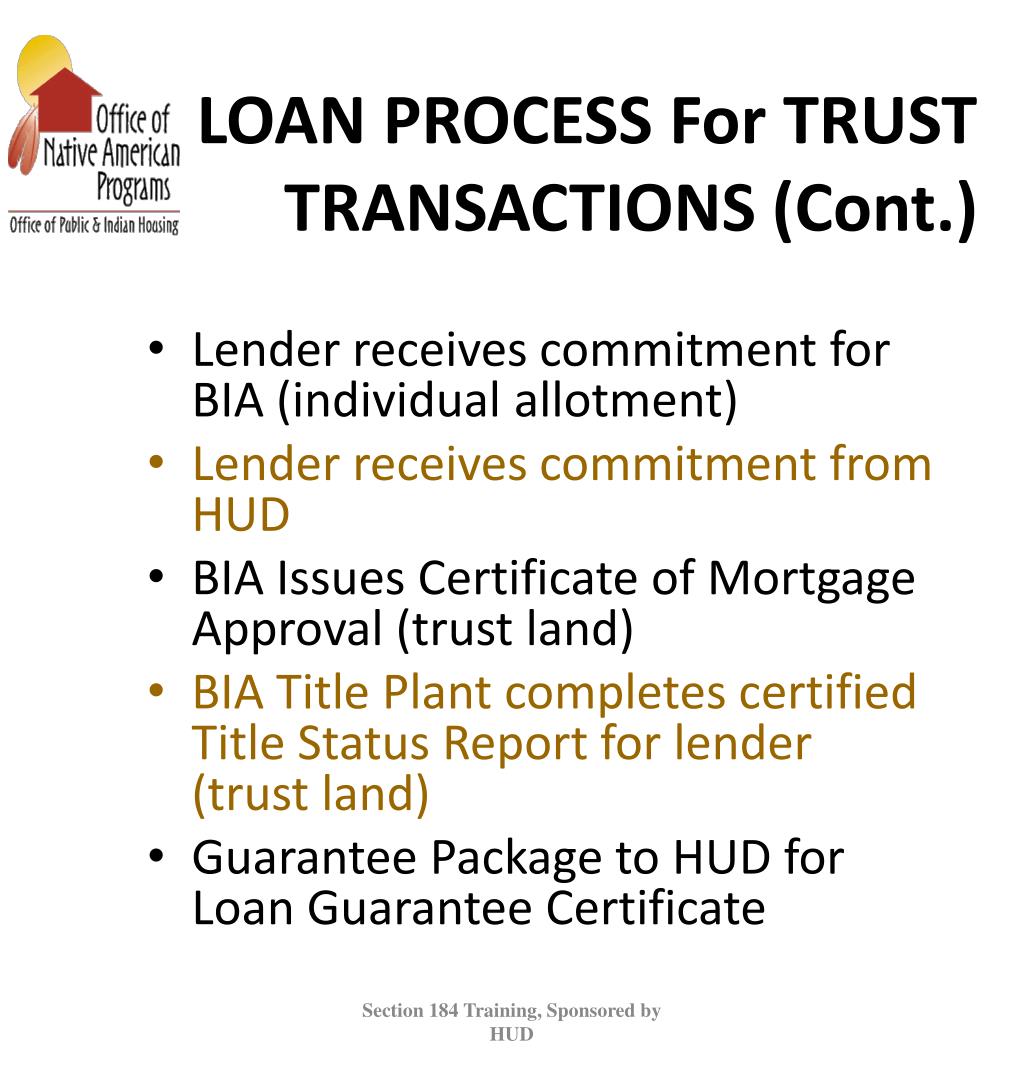
This is where the HUD 184 loan process diverges most significantly. After the lender gathers all necessary documentation (income, credit, appraisal, etc.), the loan package is submitted for underwriting. Once the lender approves the loan, it must then be sent to HUD’s ONAP for final endorsement. HUD reviews the loan package to ensure it complies with all program requirements. This step adds an additional layer of scrutiny and can extend the processing time compared to other loan types.
7. Closing:
Once HUD endorses the loan, you are cleared to close. This involves signing all final loan documents, paying closing costs, and officially taking ownership of the home. For homes on tribal land, the closing process may involve additional tribal approvals or lease agreements, which your lender and title company should be familiar with.
8. Loan Servicing:
After closing, your loan will be serviced by a mortgage company (which may or may not be the original lender). You will make your monthly mortgage payments, including principal, interest, taxes, and insurance (PITI), to this servicer.
Advantages (Pros) of the HUD 184 Loan Program
The HUD 184 loan offers several compelling benefits that make it an attractive option for its target demographic:
-
Low Down Payment Requirements: This is one of the most significant advantages. Borrowers typically need only 2.25% down for loans over $50,000 and 1.25% down for loans under $50,000. This is considerably lower than many conventional loans (which often require 5-20%) and even slightly lower than FHA loans (3.5%). For homes on tribal trust land, a 0% down payment is possible under certain conditions.
-
Flexible Credit Requirements: While not a "no credit check" loan, HUD 184 is generally more forgiving of past credit issues than conventional loans. Lenders often consider a broader range of financial factors and may accept lower credit scores, making homeownership accessible to individuals who might otherwise be denied.
-
Competitive, Fixed Interest Rates: HUD 184 loans typically offer fixed interest rates, providing stability and predictability in monthly payments for the life of the loan. These rates are often competitive with, or even lower than, FHA and conventional loans due to the government guarantee.
-
Acceptance on Tribal and Trust Lands: This is the program’s unique selling proposition. It is specifically designed to facilitate homeownership on lands where conventional financing can be extremely difficult, if not impossible, to obtain. It addresses the complexities of leasehold interests and tribal sovereignty.
-
Limited Mortgage Insurance: While HUD 184 loans do require mortgage insurance, it’s structured differently and can be less burdensome than FHA mortgage insurance. There’s an Upfront Mortgage Insurance Premium (UFMIP) of 1.00% of the loan amount (which can be financed into the loan) and an Annual Mortgage Insurance Premium (MIP) of 0.25% for loans with a loan-to-value (LTV) greater than 90%, or 0.15% for loans with an LTV less than or equal to 90%. Crucially, the annual MIP can be cancelled once certain equity thresholds are met, unlike FHA MIP which typically lasts for the life of the loan.
-
No Loan Limits (within reason): Unlike FHA and conventional loans that have strict county-specific loan limits, the HUD 184 program generally does not have an upper loan limit imposed by HUD, allowing for flexibility in higher-cost areas. However, individual lenders may have their own internal limits, and the loan amount must be reasonable for the property’s value.
-
Refinancing Options: The program allows for both rate and term refinances and cash-out refinances, providing flexibility for existing homeowners to improve their financial situation or access equity.
-
Support for Economic Development: By promoting homeownership, the HUD 184 program indirectly supports economic development within Native American communities, fostering stability, local investment, and wealth creation.
Disadvantages (Cons) of the HUD 184 Loan Program
Despite its many benefits, the HUD 184 loan program is not without its drawbacks. Potential borrowers should be aware of these challenges:
-
Eligibility Restrictions: The most significant limitation is its exclusivity. Only enrolled members of federally recognized tribes are eligible. This means a large portion of the population cannot access this specific loan product, even if they share similar financial challenges.
-
Limited Lender Availability: Because it’s a specialized program, fewer lenders offer HUD 184 loans compared to conventional or FHA mortgages. This can make it challenging to find a lender, especially in areas not densely populated by Native American communities, potentially limiting options for borrowers.
-
Geographic Restrictions: The property must be located in an eligible area, which often means within or near tribal lands or designated areas. This limits the choice of homes for borrowers who wish to purchase property outside of these specific zones.
-
Perceived Bureaucracy and Processing Time: The requirement for HUD endorsement adds an extra layer of review to the process. While necessary for program integrity, it can lead to longer processing times compared to other loan types. Borrowers often report that HUD 184 loans can take longer to close, which might be a disadvantage in competitive housing markets where sellers prefer quicker closings.
-
Mortgage Insurance Costs: Although the MIP structure is often more favorable than FHA, it is still an additional cost that borrowers must pay. The UFMIP and annual MIP add to the overall expense of the loan, increasing monthly payments.
-
Property Requirements and Appraisal Complexities: Homes must meet HUD’s minimum property standards, which can sometimes require repairs before closing. For homes on tribal trust land, the appraisal process can be more involved due to the unique nature of leasehold interests versus fee simple ownership, potentially causing delays.
-
Awareness and Education: The HUD 184 program is not as widely known or understood by the general public, real estate agents, or even some lenders. This lack of awareness can lead to misinformation or missed opportunities for eligible borrowers.
Is the HUD 184 Loan Right for You? (Purchase Recommendations)
The HUD Section 184 loan is a powerful and purpose-built financial instrument, but it’s not a one-size-fits-all solution. Here’s a recommendation guide to help you determine if it’s the right fit:
The HUD 184 Loan is Highly Recommended For:
- Enrolled Members of Federally Recognized Tribes: This is the absolute prerequisite. If you meet this criterion, the program is designed specifically for you.
- Individuals Looking to Purchase on Tribal or Trust Lands: This is where the HUD 184 loan truly shines. It provides a viable and often the only path to homeownership in these unique land tenure environments.
- First-Time Homebuyers with Limited Down Payment Funds: The exceptionally low down payment requirements make it an accessible option for those who haven’t had the opportunity to save a large sum.
- Borrowers with Less-Than-Perfect Credit: If your credit score is good but not excellent, or if you have some past financial blemishes, the HUD 184’s flexible underwriting can be a lifesaver.
- Those Seeking Stability with Fixed Interest Rates: The guarantee of a fixed rate provides peace of mind and predictable monthly housing costs over the long term.
- Individuals Committed to Homeownership within Native American Communities: By utilizing this program, you are contributing to the economic self-sufficiency and stability of your community.
The HUD 184 Loan Might NOT Be the Best Fit For:
- Non-Eligible Individuals: If you are not an enrolled member of a federally recognized tribe, this program is simply not available to you.
- Borrowers Seeking the Absolute Quickest Closing: While many HUD 184 loans close efficiently, the added step of HUD endorsement can sometimes lead to longer processing times compared to highly streamlined conventional loans.
- Those Prioritizing Maximum Lender Choice: Due to its specialized nature, the pool of HUD 184 approved lenders is smaller than for conventional or FHA loans.
- Borrowers Who Can Secure a Conventional Loan with 20%+ Down and No PMI: If you have excellent credit, a substantial down payment, and can avoid Private Mortgage Insurance (PMI) altogether with a conventional loan, that might be a slightly more cost-effective option in the long run.
Key Decision Factors:
When considering a HUD 184 loan, ask yourself:
- Am I eligible? (Tribal enrollment)
- Is the property in an eligible area?
- Do I value lower down payments and flexible credit over potentially faster closing times?
- Am I comfortable with the mortgage insurance structure?
Conclusion
The HUD Section 184 Indian Home Loan Guarantee Program stands as a testament to targeted financial innovation, directly addressing the historical and systemic barriers to homeownership faced by Native American and Alaska Native communities. It is a powerful and often indispensable tool for eligible individuals and families seeking to achieve the dream of owning a home, particularly on tribal and trust lands where other financing options are scarce.
While it comes with its own set of unique processes and occasional delays, the advantages of low down payments, flexible credit, competitive fixed rates, and its fundamental ability to operate on diverse land tenures far outweigh the disadvantages for its intended beneficiaries. For those who meet the eligibility criteria, understanding and exploring the HUD 184 loan process is not just a recommendation; it is an essential step towards unlocking a pathway to generational wealth, stability, and cultural preservation through homeownership. By choosing an experienced lender and educating oneself on the process, Native American and Alaska Native individuals can confidently leverage this program to build a secure future for themselves and their families.


