Building on Sacred Ground: A Comprehensive Guide to Native American Home Loans
Homeownership is a cornerstone of the American dream, offering stability, wealth accumulation, and a sense of belonging. Yet, for many Native Americans, this dream has historically been elusive, hindered by unique challenges rooted in land tenure systems, economic disparities, and a lack of culturally competent financial services. Recognizing these systemic barriers, specialized home loan programs have emerged, designed to empower Indigenous individuals and tribal communities to achieve their housing aspirations.
This article delves into the intricacies of Native American home loans, primarily focusing on the Department of Housing and Urban Development’s (HUD) Section 184 Indian Home Loan Guarantee Program, while also touching upon other relevant options. We will explore how these programs work, their distinct advantages and disadvantages, and ultimately provide a recommendation for prospective homeowners.
The Unique Landscape of Native American Homeownership
Before diving into the specifics of the loan programs, it’s crucial to understand the distinct context of Native American land and housing.
-
Land Tenure Systems: A significant hurdle is the complex nature of land ownership within Indian Country.
- Trust Land: This land is held in trust by the U.S. government for the benefit of individual Native Americans or tribes. It cannot be bought or sold without federal approval and is not subject to state or local property taxes. Traditional mortgages are difficult to obtain on trust land because lenders cannot easily foreclose or take title to the property.
- Restricted Fee Land: Similar to trust land, but individuals hold the title, though its alienation is restricted by federal law.
- Fee Simple Land: This is privately owned land, much like any other property in the U.S., and is subject to state and local laws and taxes. Mortgages on fee simple land within or near reservations are more straightforward but can still face unique appraisal and market challenges.
-
Economic Disparities: Many Native American communities face higher rates of poverty, unemployment, and lower median incomes compared to the general U.S. population. These factors can make it challenging to meet traditional lending criteria.
-
Infrastructure Gaps: Remote locations, lack of access to public utilities, and underdeveloped infrastructure on some reservations can complicate construction, appraisals, and overall marketability for lenders.
-
Cultural Considerations: The value placed on community, tribal sovereignty, and traditional ways of life often isn’t adequately addressed by conventional financial institutions.

These challenges underscore the necessity of specialized lending solutions that understand and navigate this unique environment.
The Cornerstone: The HUD Section 184 Indian Home Loan Guarantee Program
The HUD Section 184 program is the most prominent and impactful home loan program designed specifically for Native Americans. Established by the Indian and Native American Housing and Self-Determination Act of 1996 (NAHASDA), it addresses the severe lack of housing and access to financing in tribal communities.
How it Works:
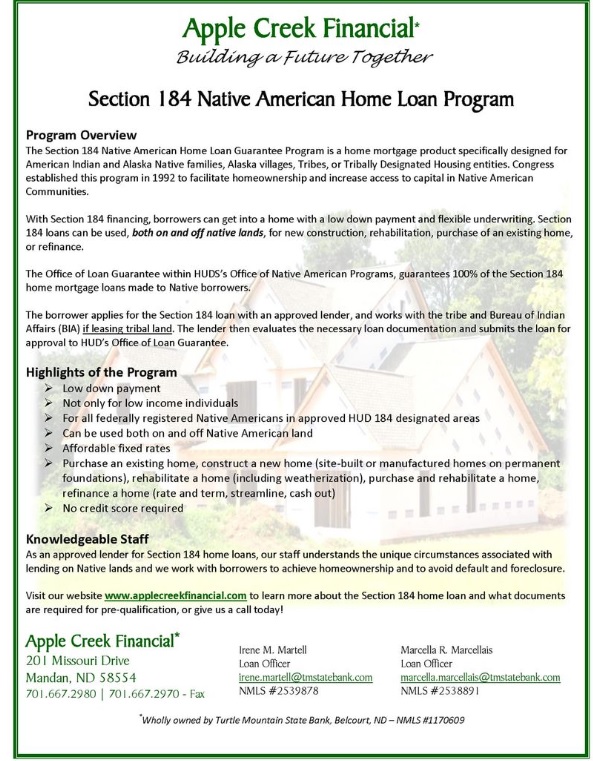
The Section 184 program is not a direct loan program. Instead, HUD provides a guarantee to private lenders (banks, credit unions, and mortgage companies) that make loans to eligible Native American borrowers. This guarantee protects the lender against loss in the event of default, making them more willing to lend in areas and to individuals they might otherwise consider high-risk.
Eligibility:
To qualify for a Section 184 loan, borrowers must be:
- An enrolled member of a federally recognized Native American Tribe.
- An Alaska Native.
- An Indian Housing Authority (IHA) or a Tribally Designated Housing Entity (TDHE).
The property itself can be located anywhere in the United States, not just on a reservation, provided it is within an eligible area (which includes all tribal lands, Alaska Native Villages, and various other designated areas).
Key Features and Benefits:
-
Low Down Payment: One of the most attractive features is the low down payment requirement:
- 1.25% for loans over $50,000.
- 2.25% for loans $50,000 or less.
This significantly lowers the barrier to entry for many prospective homeowners.
-
Flexible Underwriting: Section 184 loans are known for their flexible underwriting standards. While credit history and income are still assessed, the program takes a more holistic view of a borrower’s financial situation, understanding that traditional credit scoring may not fully capture the creditworthiness of individuals in tribal communities. Non-traditional credit references (e.g., utility bills, rent payments) may be considered.
-
Competitive Interest Rates: Interest rates are generally market-based and competitive with conventional loans, often fixed for the life of the loan, providing predictability in monthly payments.
-
Mortgage Insurance Premium (MIP): Like FHA loans, Section 184 loans require a one-time upfront guarantee fee (1.5% of the loan amount, which can be financed into the loan) and an annual loan guarantee fee (0.25% of the outstanding principal balance). While this adds to the cost, it’s typically lower than FHA’s annual MIP.
-
Loan Uses: Section 184 loans can be used for a variety of purposes:
- Purchasing an existing home.
- Constructing a new home.
- Rehabilitating or modernizing an existing home.
- Refinancing an existing mortgage.
- Purchasing and rehabilitating a home.
- Purchasing land and constructing a home.
-
Addressing Trust Land Challenges: Crucially, the Section 184 program is designed to work on trust land. This is achieved through a ground lease (or leasehold estate) agreement between the tribal government or individual landowner and the borrower. The lease, approved by the Bureau of Indian Affairs (BIA), grants the borrower the right to occupy the land and allows the lender to secure their interest, making lending on trust land feasible.
-
Loan Limits: The maximum loan amount is determined by county-specific FHA loan limits, which vary depending on the local housing market.
Other Relevant Home Loan Options
While Section 184 is primary, other programs may also be applicable:
- VA Native American Direct Loan (NADL) Program: For eligible Native American veterans, the VA offers direct loans to purchase, construct, or improve homes on Native American trust lands. This program often boasts no down payment and no private mortgage insurance, making it highly advantageous for those who qualify.
- USDA Rural Development Home Loans (Section 502 Direct and Guaranteed): These programs support homeownership in eligible rural areas, which often include tribal lands. They offer low-income individuals and families financing with no down payment, but eligibility is based on income limits and property location within designated rural areas.
- Tribal Housing Programs: Many tribal nations operate their own housing departments or entities (TDHEs) that offer a range of housing assistance, including down payment assistance, rental programs, and sometimes direct lending or subsidies. These programs are vital for supplementing federal efforts.
- Conventional, FHA, and VA Loans (on Fee Simple Land): For Native Americans purchasing homes on fee simple land (whether on or off a reservation), traditional loan products like conventional mortgages, FHA-insured loans, and VA-guaranteed loans (for veterans) are also available. However, they may not offer the same flexibility or cultural understanding as Section 184.
Advantages (Pros) of Native American Home Loans (with emphasis on Section 184)
- Access to Homeownership on Trust Lands: This is arguably the most significant advantage. Section 184, and NADL, provide a structured pathway to homeownership on lands where traditional mortgages are virtually impossible, preserving tribal sovereignty and cultural ties to the land.
- Lower Financial Barriers: The low down payment requirements make homeownership accessible to more individuals, reducing the need for years of intensive savings.
- Flexible Underwriting: The program’s understanding of unique financial circumstances within Native American communities means that borrowers with less-than-perfect credit or non-traditional credit histories still have a viable path to homeownership.
- Competitive Interest Rates: Borrowers benefit from stable, fixed-rate loans at competitive market rates, ensuring predictable monthly housing costs.
- Culturally Competent Process: Approved Section 184 lenders often have experience working with tribal governments and understand the nuances of tribal law and customs, leading to a more streamlined and respectful process.
- Support for Community Development: By facilitating homeownership, these programs contribute to economic stability, community building, and infrastructure development within tribal nations, fostering self-determination.
- Broad Geographic Reach: The Section 184 program is available nationwide, allowing eligible Native Americans to purchase homes not only on reservations but also in urban areas, expanding their choices.
Disadvantages (Cons) and Challenges
- Limited Lender Availability: While the program operates nationwide, not all lenders are approved Section 184 lenders. This can limit options, especially in more remote areas, and may require borrowers to seek out specialized lenders.
- Eligibility Requirements: The strict requirement of being an enrolled member of a federally recognized tribe means the program is not accessible to everyone who identifies as Native American or has Native ancestry but lacks formal tribal enrollment.
- Complexity of Trust Land Transactions: While Section 184 facilitates lending on trust land, the process can still be complex. It involves coordinating with tribal governments, the Bureau of Indian Affairs (BIA), and potentially multiple landowners for the ground lease, which can extend closing times.
- Mortgage Insurance Premium (MIP): The upfront and annual guarantee fees, though lower than some alternatives, add to the overall cost of the loan and do not go away (unlike conventional loans with 20% equity).
- Appraisal Challenges: Appraising properties on tribal lands can be difficult due to limited comparable sales data, unique land characteristics, and varying infrastructure, potentially impacting loan amounts or processing times.
- Tribal Approval and Lease Agreements: For homes on trust land, the tribal government must approve the ground lease, and the BIA must approve the lease document. This introduces additional layers of bureaucracy and potential delays.
- Foreclosure Limitations: While the guarantee protects lenders, the unique legal framework of trust land can still make foreclosure a more complicated and lengthier process compared to fee simple land, which some lenders might view as a deterrent.
How to Apply for a Section 184 Loan
The application process for a Section 184 loan is similar to other mortgage applications but with some unique steps:
- Find an Approved Lender: Start by identifying lenders approved by HUD to originate Section 184 loans. HUD’s website provides a list of participating lenders.
- Pre-Qualification/Pre-Approval: Work with your chosen lender to get pre-qualified or pre-approved. This involves submitting financial documents (income, assets, debts) and allows you to understand how much you can afford.
- Gather Documentation: Be prepared to provide proof of tribal enrollment (e.g., tribal ID card, Certificate of Indian Blood – CIB), along with standard financial documents like pay stubs, tax returns, bank statements, and credit history.
- Find a Home: Once pre-approved, you can begin searching for a home. If you plan to build or purchase on trust land, ensure you understand the specific tribal requirements and the ground lease process.
- Loan Application and Underwriting: Submit a full loan application. The lender will review all documentation, order an appraisal, and begin the underwriting process, which includes assessing your eligibility and the property’s value.
- BIA and Tribal Coordination (for Trust Land): If the property is on trust land, the lender will work with you, the tribal government, and the BIA to secure the necessary lease agreements and approvals.
- Closing: Once approved, you’ll attend the closing, sign all necessary documents, and become a homeowner.
Recommendation: Is a Native American Home Loan Right for You?
For eligible Native American individuals and tribal entities, the HUD Section 184 Indian Home Loan Guarantee Program, and for veterans, the VA NADL program, represent highly recommended and often indispensable pathways to homeownership.
Strongly Recommend If:
- You are an enrolled member of a federally recognized tribe. This is the fundamental eligibility requirement.
- You wish to purchase or build a home on trust land or restricted fee land. These programs are uniquely designed to navigate the complexities of these land tenure systems.
- You are seeking a low down payment option. The 1.25% or 2.25% down payment is significantly lower than many conventional loan products.
- You have a non-traditional credit history or need more flexible underwriting standards. The program’s holistic approach to credit assessment can be a major advantage.
- You value a lending process that understands and respects tribal sovereignty and cultural nuances.
Consider Alternatives If:
- You are not an enrolled member of a federally recognized tribe. You would not be eligible for Section 184 or NADL.
- You prefer a conventional loan and have excellent credit and a substantial down payment. You might find slightly lower overall costs by avoiding MIP/guarantee fees, though this isn’t always the case.
- You are a veteran but prefer the broader options of a standard VA loan for a home on fee simple land. While NADL is excellent for trust land, a regular VA loan might be simpler for fee simple properties.
- You are in a rural area and meet income requirements for USDA Rural Development loans. These can also offer no down payment options.
Final Advice:
Before making any decisions, it is crucial to:
- Research Thoroughly: Understand the specific requirements of each program and whether they align with your personal and financial situation.
- Contact Multiple Lenders: Speak with several HUD-approved Section 184 lenders to compare terms, interest rates, and their experience with tribal communities.
- Consult with Tribal Housing Authorities: Your tribal housing authority or TDHE can be an invaluable resource, offering guidance, local programs, and assistance in navigating the process, especially concerning land leases.
- Seek Financial Counseling: A housing counselor specializing in Native American homeownership can provide personalized advice and help you prepare for the application process.
In conclusion, Native American home loan programs, particularly the HUD Section 184, are vital tools that bridge historical gaps and empower Indigenous communities. By offering flexible, culturally sensitive, and financially accessible options, they not only facilitate individual homeownership but also strengthen tribal nations, fostering self-determination and building a more equitable future on ancestral lands.


